
Extraordinary planning landed the Mayor’s Office of Employment Development as the anchor tenant in Reservoir Square’s new commercial space. Image courtesy of MCB Real Estate.
From bespoke projects in distressed neighborhoods to reinventions of century-old industrial sites to the green build of an entirely new community, developers are forging different paths to creating successful mixed-use developments.
In West Baltimore, the site of the current Reservoir Square development was “a veritable poster child for the failures of the urban renewal movement,” according to MCB Real Estate. The site’s retail center was nicknamed Murder Mall.
MCB Co-founder and Managing Partner P. David Bramble grew up nearby and regularly visited his mother’s office on the site. Years later, he took on a passion project of transforming the site of the condemned public housing project and failing mall into a thriving mixed-use area.
Early plans for the eight-acre parcel known as Madison Park North featured an “innovation center” with workforce rental housing, a mix of retail and new job opportunities. That vision, however, was thwarted by the challenges of developing in a historically distressed, disinvested and redlined area.
“This project has lived and died and come back to life maybe five times now,” said Theresa Stegman, Vice President of Development and Structured Finance at MCB.
A major obstacle to the development was a steep appraisal gap on area properties.
“The long-term effects of redlining have depressed property values and rents in this area, and traditional bank debt is either unavailable or insufficient to cover project costs,” Stegman said.
 So, MCB and its project partners, Atapco Properties and MLR Partners, reimagined their master plan to build for-sale, market-rate townhouses, rather than apartments. Through close partnering with state and city officials and financing partners, they pieced together an exceptionally complex capital stack that includes a bridge loan from the Neighborhood Impact Investment Fund and an arrangement for the Maryland Economic Development Corporation to “purchase” portions of improved infrastructure onsite.
The developers also landed the Mayor’s Office of Employment Development (MOED) as the anchor tenant of Reservoir Square’s commercial section. Through two years of intricate and sometimes reverse-order planning, the development team determined how much space MOED would need in a consolidated facility (its operations are currently spread across multiple sites) then designed the building to provide that space, support a lease rate the city could afford and structure a bond package to cover debt servicing on the construction costs.
The impact of that revised development plan is big and growing. Townhouse sales have been brisk driving demand into the high $400,000s. Reservoir Square has attracted a grocery store (a prime goal) and developers are currently in discussions with other potential retail tenants to serve the growing residential base and the 200 city employees who will begin working on site by late 2026, Stegman said.
“I am pleased that we have been able to demonstrate that market-rate development is possible outside the White L in Baltimore,” she said. (White L refers to the L-shaped cluster of predominantly white and more heavily invested neighborhoods in Baltimore.) “This is an important proof of concept not just for Baltimore, but for any community that needs to be more creative in how they attract investment.”
The project, she added, also shows that efforts to address vacant houses or develop new housing need to include a developer who can revitalize large blighted or underutilized commercial sites. “The multiplier effect of involving a capable developer who can address the big vacant eyesore and bring commercial development to a residential neighborhood, cannot be understated.”
Revitalizing neighborhoods
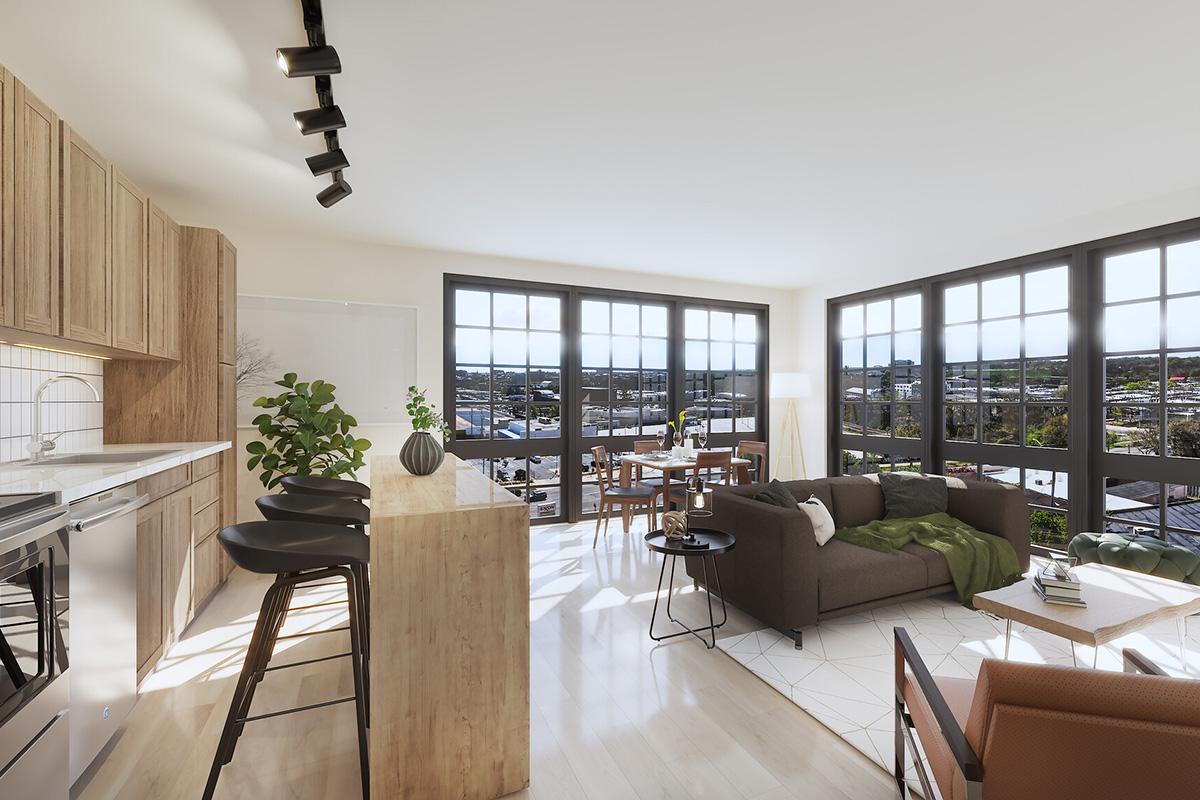
Design decisions to create floor-to-ceiling windows in apartments (above) and create a spare, industrial style in the commercial space (below) helped The Service Center be both attractive and affordable. Photos courtesy of JP2 Architects and Seawall Development.
In Automotive Triangle where Howard, Maryland and North avenues converge, Seawall Development recently completed a $30 million transformation of a former automobile business. Described as a community hub, the 82,000-square-foot Service Center contains 64 fully leased, workforce apartments and 25,000 square feet of commercial space that is mostly leased by nonprofits and a children’s therapy practice. The building also houses a Service Works program where residents and others can connect with nonprofits and volunteer for efforts that benefit their neighborhood.
Seawall describes The Service Center as an inclusive, neighborhood-driven development that supports modest-income earners as well as the history, needs and aspirations of a neighborhood that has experienced under-investment. Its blend of nonprofit uses with market-rate, but affordable, apartments makes the development economically sustainable.

But that doesn’t mean it was an easy project to complete.
“Financially it works, but, yes, it’s tight,” said Matt Pinto, Development Manager at Seawall. “But we have good relationships with our lenders and our equity partners, and we’ve got patient capital so we can let things grow as they need to.”
Smart, financially savvy and innovative design was also key to the project’s success.
“Most mixed-use projects have majority retail at their base and then multifamily above, so this was a different take on mixed use with nonprofits, community space, a little retail and the apartments,” said Gordon Godat, Principal at JP2 Architects.
In addition to supporting complex program requirements, designers had to work within budget constraints.
“Like many mission-driven developments, resources were limited, so every design move had to balance function, durability and impact,” said Vicki Myers, Associate Principle at JP2. “The key was knowing where to invest and where to simplify – creating interiors that felt warm and authentic without unnecessary embellishment.”
Designers “leaned into the utilitarian, industrial heritage of the surrounding neighborhood” and paired the building’s exposed concrete structure and open ceilings with steel detailing, pops of bold color and lighting that added warmth, Myers said.
They also brought drama and light to the small, affordable apartments through “the conscious decision to do floor-to-ceiling glass,” Godat said.
The success of The Service Center project which recently won a ULI Wavemaker Award, also stemmed from some processes Seawall honed through previous mixed-use developments, including Miller’s Court and Remington Row.
“We never want to feel like guests in a neighborhood,” Pinto said.

Unconventional but successful mixed-use projects by Seawall Development have turned Remington into a vibrant neighborhood. Photo courtesy of Seawall Development.
Seawall has always conducted extensive communication with neighborhood groups and residents to determine what the area needs and aspires to, and what “soul” the new building needs to have.
Pinto added Seawall also constantly evaluates development plans and is willing to dramatically change a plan mid-course when needed. For The Service Center, Seawall aborted a long-pursued plan to redevelop existing buildings when it concluded the costs would risk the project’s viability.
“It takes a lot of courage to do that: to recognize that you’re trying to build the wrong thing, to go back to square one and start over, despite all the time, effort and energy you have put into the project,” he said.
But the impacts of that approach have been dramatic.
“Remington was once a forgotten neighborhood that you just drove through from Hopkins to I-83,” Pinto said. “Now, there is vibrancy in Remington and things to do and new businesses popping up.”
Small town opportunities
Innovative mixed-use projects, however, don’t only happen on dense city sites.
In Cambridge, Cross Street Partners transformed a former Phillips Packing Company plant — a century-old, dilapidated and long-abandoned building — into The Packing House, a 60,000-square-foot, mixed-use facility with office, retail, restaurant, community, exhibition and event space.
“This was our first rural project,” said Margaret Norfleet-Neff, Development Director at Cross Street.
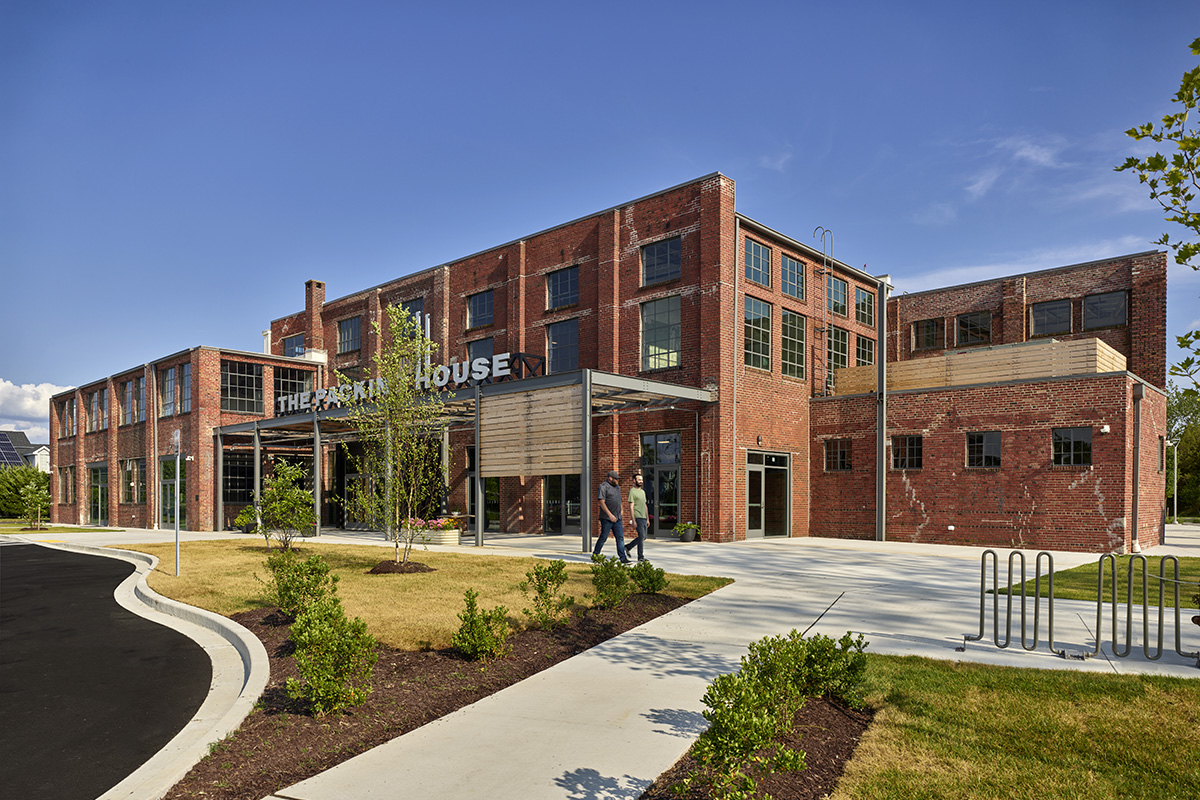
The transformation of a former Phillips Packing Company plant into a mixed-use project has created workspaces for large employers and startup entrepreneurs, plus event, retail and community space. Images courtesy of Cross Street Partners.
The company was drawn to the property by the “gritty, wonderful” character of Cambridge and because “decaying, old buildings are the elixir for us,” Norfleet-Neff said.
Consultations with the community identified the area’s real estate needs and opportunities to combine uses and stoke future growth. For example, The Packing House includes coworking space to support startup companies and a commercial kitchen to support pop-ups, early-stage food companies and events. Its bright, lofty event space has attracted a busy schedule of weddings, fundraisers, corporate gatherings, tourism/recreation promotions and community-education sessions.
The project, Norfleet-Neff said, has demonstrated how a thoughtful mix of uses and a bold design (The Packing House blends historical and modern industrial styles) can complement historic downtowns and catalyze growth in small towns.
“It shows other options for creating a vibrant downtown and more ways of attracting people to the area,” she said. “For the companies functioning in The Packing House, it is providing greater visibility and connections and opportunities for them to find synergies that help grow their companies.”
In Elkton, a very different and massive mixed-use development in underway. The Southfields development is transforming 630 acres into an $800 million, planned live-work-play community, designed to include single family homes, apartments, condominiums and senior living; commercial, retail, restaurant and hotel space; more than 300 acres of industrial development; 280 acres of open space and recreation parks; and a signature, 100,000-square-foot indoor sports complex.

The inclusion of a coworking space and a commercial kitchen in The Packing House creates an environment to grow early-stage companies. Photo courtesy of Cross Street Partners.
Sean Langford, Senior Vice President of MacKenzie Commercial Real Estate Services, said marketing the Southfields property is both an exciting, once-in-a-lifetime opportunity and a challenging sell. Last fall, Langford helped broker the purchase of a 13-acre retail site at Southfields by Alliance Capital.
“If you take the 40,000-foot view of this project, it’s a very, very hard sell. It’s kind of in the middle of no place,” Langford said.
But a closer look reveals numerous, strong, selling points for Southfields.
“It’s a business-friendly city, a business-friendly county. They’ve got available land and they’ve got infrastructure,” Langford said.
Its proximity to Route 40 is attractive to industrial operations. Meanwhile, retailers are starting to see opportunities in the region’s growing population and projections that the sports complex could attract 250,000 families a year for competitions, he said.
“It’s exciting to be part of something this special,” Langford said. “Southfields will be an extremely significant economic boost to Elkton and Cecil County.”