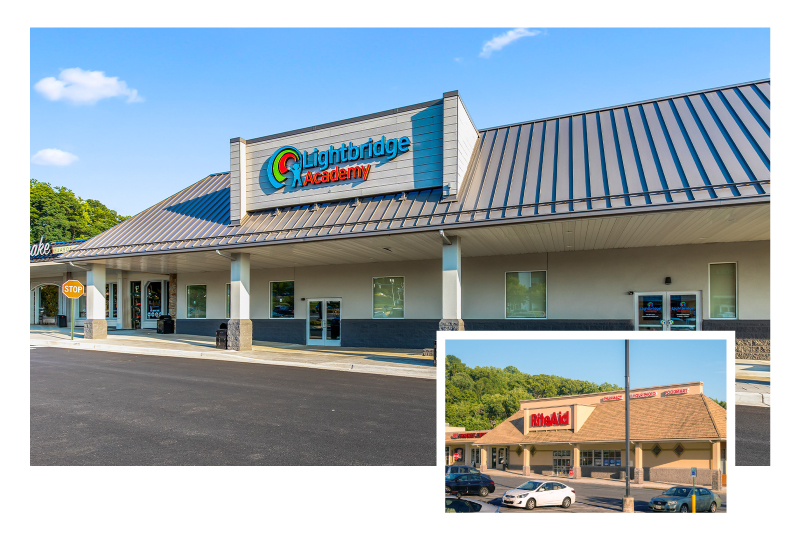
When Rite Aid pulled out of Padonia Village Shopping Center, Continental Realty Corporation transformed the space into a childcare center. Photos courtesy of Continental Realty Corporation.
Store closures by Rite Aid, CVS, Joann Fabrics and Crafts, Party City, Big Lots, Bed Bath & Beyond, and other major retailers have peppered Central Maryland with empty storefronts. For landlords and brokers, those closures have created a mix of real estate headaches, business complexities and new opportunities.
“When retail real estate goes dark, it’s actually a good thing for our marketplace,” said Tom Fidler, Executive Vice President and Principal of MacKenzie Retail. “The Greater Baltimore, Central Maryland area has one of the lowest retail vacancy rates in the Mid-Atlantic and probably anywhere east of the Mississippi.”
MacKenzie Commercial Real Estate Services’ 2025 Q3 market report pegged the region’s retail vacancy rate at 6.35 percent while several sub-markets posted dramatically lower rates: 1.86 percent in the BWI Corridor, 2.67 percent in Carroll County and 3.85 percent in Columbia.
In recent years, Continental Realty Corporation has orchestrated the revival of multiple spaces vacated by struggling retailers. In Padonia Village Shopping Center, the company turned a former Rite Aid into a Lightbridge Academy childcare center. At Park Plaza in Severna Park, a Joann Fabrics store became a Mom’s Organic Market. In the Center at Hagerstown, a former Bed Bath & Beyond became a Crunch Fitness.
Those transformations were successful, but not simple.
“When you convert to a totally different use, there are always challenges,” said Kristina O’Keefe, Senior Vice President, Retail Operations at Continental Realty Corporation. “With the Rite Aid-to-Lightbridge project, we had to figure out how to add an outdoor play area, how to attach it to the building and how to accommodate parent drop-off and pick-up.”
With the Joann-to-Mom’s deal, “we had to figure out how to deal with the fact that deliveries are a lot more frequent to a grocery store than to a soft-goods store,” she added. “Daily deliveries, loading dock operations, the delivery path, customer access, parking and cart corrals had to be figured out in the Mom’s deal.”
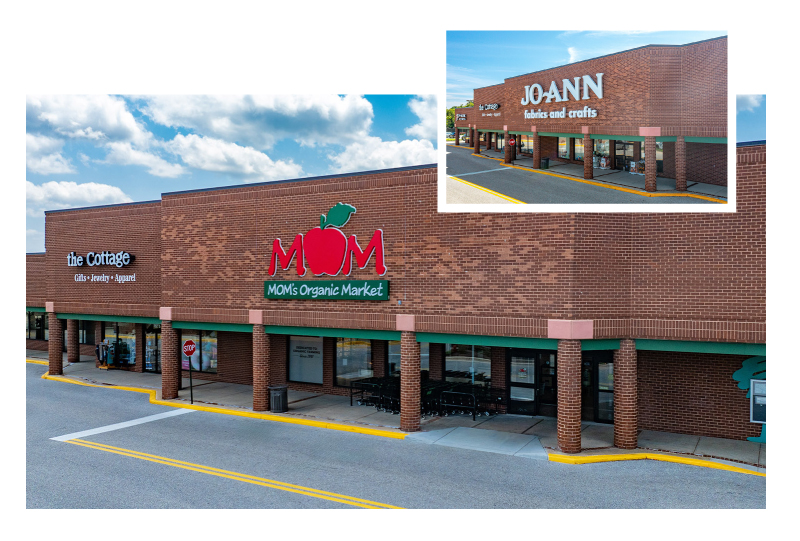
Turning a former Joann Fabrics into a Mom’s grocery meant accommodating more daily deliveries, customer traffic and cart corals. Photos courtesy of Continental Realty Corporation.
Some large, vacated spaces prove more difficult to fill.
“There is an inherent issue in the world of retail real estate,” Fidler said. “Post-pandemic, most national retailers learned how to do more with less space. They no longer need the 50,000-square-foot or 30,000-square-foot space and the bucket of prospects to refill that space has been drastically reduced.”
When a Shoppers supermarket vacated the Freedom Village Shopping Center in Eldersburg, Continental was left with 60,000 square feet of empty space. The company ultimately divided the box into three retail spaces and leased them to a smaller grocery store, a medical office and a thrift store.
Matching new tenants to empty spaces is always a huge undertaking that requires careful assessment of potential tenants, retail trends and the best, long-term uses for the retail center, O’Keefe said.
“These big boxes and who occupies them define your property to an extent,” she said. “Turning a vacant box into something new is a decision you have to think long and hard about. These lease terms are longer — 10 years with multiple options. It’s a more sophisticated negotiation and these deals are more expensive, especially if you are splitting a space and giving TI. I think sometimes not filling a box is the best decision for the moment. You don’t want to rush into leasing to the wrong tenant.”
Stand-alone retail sites — such as former pharmacies — pose a different challenge.
“Ten years ago when everyone was building Walgreens and CVS and Rite Aids, we knew this was a train that was going to derail. There was no way you could put all those stores next to one another and have everyone survive,” Fidler said. “Now our problem is these buildings are antiquated. They’re typically 10,000 to 12,000 square feet and there are few active prospects for that square footage. And those buildings were designed not to be broken into multiple bays, so it’s almost cheaper to tear them down and rebuild on the site.”
Last fall, MacKenzie brokered the sale of a former Rite Aid in Baltimore City to a physical, occupational and speech therapy company.
Medical services can fit nicely into former pharmacies, but the financials can be tricky, Fidler said.
“The challenge is that medical typically doesn’t yield the returns that food or other services do in the retail sector. They don’t have a big pro forma to pay big rent,” he said. “So, sometimes there has to be an adjustment in the property owner’s expectations. Sometimes you find a medical tenant who will be there for the next 10 or 15 years, but they can only pay 80 percent of what you thought your property was worth.”
That stand-alone property dilemma may become more prevalent in the coming year.
“We have a growing inventory of bank sites,” Fidler said.
As online banking has dramatically decreased the need to walk into a branch, banks are opting not to renew leases. In Central Maryland, that trend has already emptied nearly 60 properties — mostly older, 2,000-square-foot, standalone buildings on prominent roadside sites. That number is expected to double this year.
Featured in this article: MacKenzie Commercial Real Estate Services, Continental Realty Corporation