 After years of feeling the impacts of high interest rates and construction costs, a pullback in industrial activity and a deflated office market, commercial real estate in northern Maryland is seeing a promising mix of new construction, redevelopments, site tours, tenant deals, and hopeful economic signs.
In Cecil, Harford and northern Baltimore counties, CRE professionals are seeing high demand for limited flex spaces, localized office shortages, increasing tours of industrial properties, and a massive, mixed-use development that promises to fuel the region’s economy.
Embracing mixed use
In Cecil County, the $800 million, 650-acre, Southfields of Elkton project is developing residential, retail, industrial and sports facilities.
Greystar recently completed a 326-unit, multi-family community while D.R. Horton has started building single-family homes. Southfields’ first industrial building, an 800,000-square-foot warehouse, was completed, leased and sold in 2025, and a second warehouse is in the planning stages.
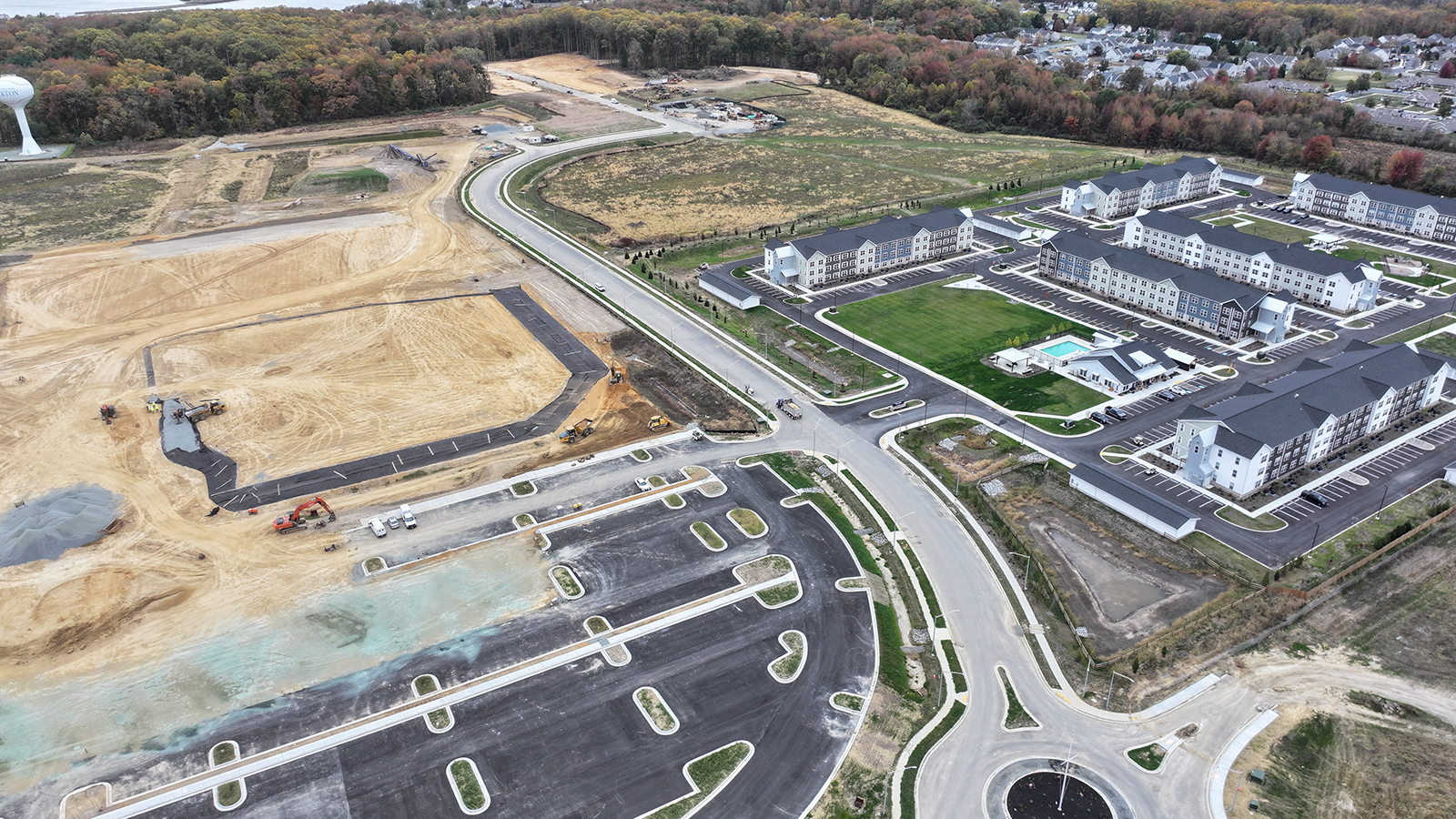
A decision to embrace mixed-use is enabling residential, retail, industrial and recreational to move forward at Southfields of Elkton. Photo courtesy of Stonewall Capital.
Construction of a 12-acre retail center is expected to begin later this spring. Deals have already been signed for two fast-casual restaurants, a Wawa and a national-brand hotel. And a new regional sports complex which is expected to attract thousands of families annually, is set to be completed by spring 2027.
“I was confident the market was there for this development,” said Ray Jackson, Principal at Stonewall Capital.
The keys to successfully developing Southfields, however, lay in shifting away from the region’s original desire for an all-residential development to a mixed-use plan, and in forging strong partnerships with Cecil County, the Town of Elkton, the State of Maryland, and multiple real estate companies, Jackson said.
Those partnerships created a Planned Unit Development and spared developers from the traditional challenges of entitling land. It also produced a round of municipal bonds to finance the sports complex.
Industrial advantage
“This was our first foray into the industrial market,” Jackson said. “I was incredibly fortunate to be aligned with folks at Cushman and Wakefield and Trammel Crow, and they were bullish on this market. There’s not a lot of industrial opportunities north on I-95, especially in South Jersey. We have a strategic advantage in our easy access to 95 and a competitive advantage on price.”
“Elkton specifically but also broader Cecil County sees a little bit different level of tenant demand, given its proximity to the Northeast,” said McLane Fisher, Vice Chairman, Logistics and Industrial Services at Cushman and Wakefield.
Sites that can satisfy the prime needs of industrial tenants — good highway access, modern buildings, robust utilities, and adequate auto and trailer storage — are “positioned to capitalize on leasing opportunities,” Fisher said.
Cecil County properties, he added, can offer tenants lower overall occupancy costs. Compared to New Jersey properties that lease for $11 to $15 a square foot, “we’re generally striking $7 to $10 a square foot on a net basis,” he said.
Operating costs are further reduced by the fact that several industrial properties, including Southfields and MRP Industrial’s Bainbridge development, are in an enterprise zone.
“We’re still at the beginning of the enterprise zone tax advantage status, so that’s a pretty significant discount for our tenants,” said Kate Nolan Bryden, Senior Vice President of MRP Industrial. “We also have a sales-and-use tax exemption so any tenant who is going to make a significant investment in building improvements, like racking or conveyors or automation, won’t have the six percent Maryland sales tax applied to the cost of those goods.”
Bainbridge’s location is also an advantage, Nolan Bryden said. “It’s between the Baltimore County East market and Delaware so it can easily service Baltimore, Washington D.C., and also Philadelphia, typically at a discount.”

Northern industrial developments, such as Bainbridge, have significant tax advantages and lower tenant costs than some competing jurisdictions. Photo courtesy of MRP Industrial.
Interest in industrial properties generally diminished with the sector’s slowdown in 2023.
“We’ve started to see more tenant demand in the first part of this year,” she said, possibly due to positive forecasts by major retailers and signs of potential cargo growth at the Port of Baltimore and Tradepoint Atlantic.”
MRP has active prospects considering a completed, 605,000-square-foot building at Bainbridge “and we have another pad site that can become a building up to 378,000 square feet that is a great build-to-suit opportunity for a user looking to occupy within 18 months,” Nolan Bryden said.
Flex shortage
Elsewhere around northern Maryland, “the market continues to tighten for flex space,” said Patrick Smith, Vice President, MacKenzie Commercial Real Estate Services.
“If somebody is looking for flex space in Forest Hill or Bel Air or north of that, it’s totally full and anything that becomes available gets leased right away,” said Tom Mottley, Senior Vice President and Principal, Brokerage at MacKenzie.
“In Harford County, flex is very tight and nothing new is being built. But office is also strong in the county,” said Beetle Smith, Senior Vice President, Brokerage at MacKenzie. “You can’t find office space over 3,000 square feet in Harford County, so you have defense contractors taking small spaces – 2,000 and 3,000 square feet.”
That space shortage is driving some changes in leasing rates and redevelopment projects.
“People come to Harford County and they are surprised at how high our rental rates are,” Mottley said. Full-service flex rates are now comparable to rates charged in the York Road corridor and “flex rates are getting close to office rental numbers.”
Increasingly, those market conditions are making redevelopment projects viable.
In Hunt Valley, Patrick Smith convinced a client to reinvent an underperforming office building. Crews gutted the interior of the two-story building, installed new HVAC and lighting, and turned it into a 15,000-square-foot flex building.
“As soon as construction was completed, it started to lease,” Smith said. “And every time we got a new proposal, I told the landlord to increase the rent by 25 cents.”
Companies featured in this article: Stonewall Capital, Cushman & Wakefield, MRP Industrial, MacKenzie Commercial Real Estate Services