The traditional office market may be wrestling with diminished demand and heightened costs, but one submarket – the Sensitive Compartmented Information Facility (SCIF) market – is enjoying strong demand while tackling new requirements for technological advances.

A growing trend in SCIF projects is integrated design: making SCIF space look as attractive as non-classified Class A office space in order to attract workers. Photo courtesy of Alain Jaramillo.
“There is a lot of demand for SCIF space from defense contractors, especially in the area of cybersecurity, as Department of Defense contracts generally require mission work to be performed out of secure space to prevent physical and electronic surveillance,” said Greg Prossner, Senior Vice President of COPT Defense Properties. “The Department of Defense budget for cybersecurity has increased roughly 50 percent over the past five years, which has created a tremendous tailwind for small and large cyber contractors, especially in the submarkets near Fort Meade, Maryland, which is home to U.S. Cyber Command.”
Adjacent to Fort Meade, COPT Defense Properties developed a 4.3 million square foot park – The National Business Park, or NBP – to serve the U.S. Government and defense contractors, with roughly 80 % of the park leases containing SCIF space.
Arium AE is seeing a growing demand for SCIFs, said Brian Frels, Principal.
“We’re seeing a lot of different security missions, contractor expansions and modernization efforts,” he said. “At any moment in time, we’re probably working on half a dozen SCIFs or more, and we do 30 to 40 a year.”
Despite changing policy priorities and disagreements among federal politicians, Prossner expects “continued growth” in SCIF demand “because, at the end of the day, there is always bipartisan support for defense spending, especially as it relates to cybersecurity given the growing cyber threats from foreign adversaries.”
The SCIF market, however, is facing some changes, challenges and opportunities.
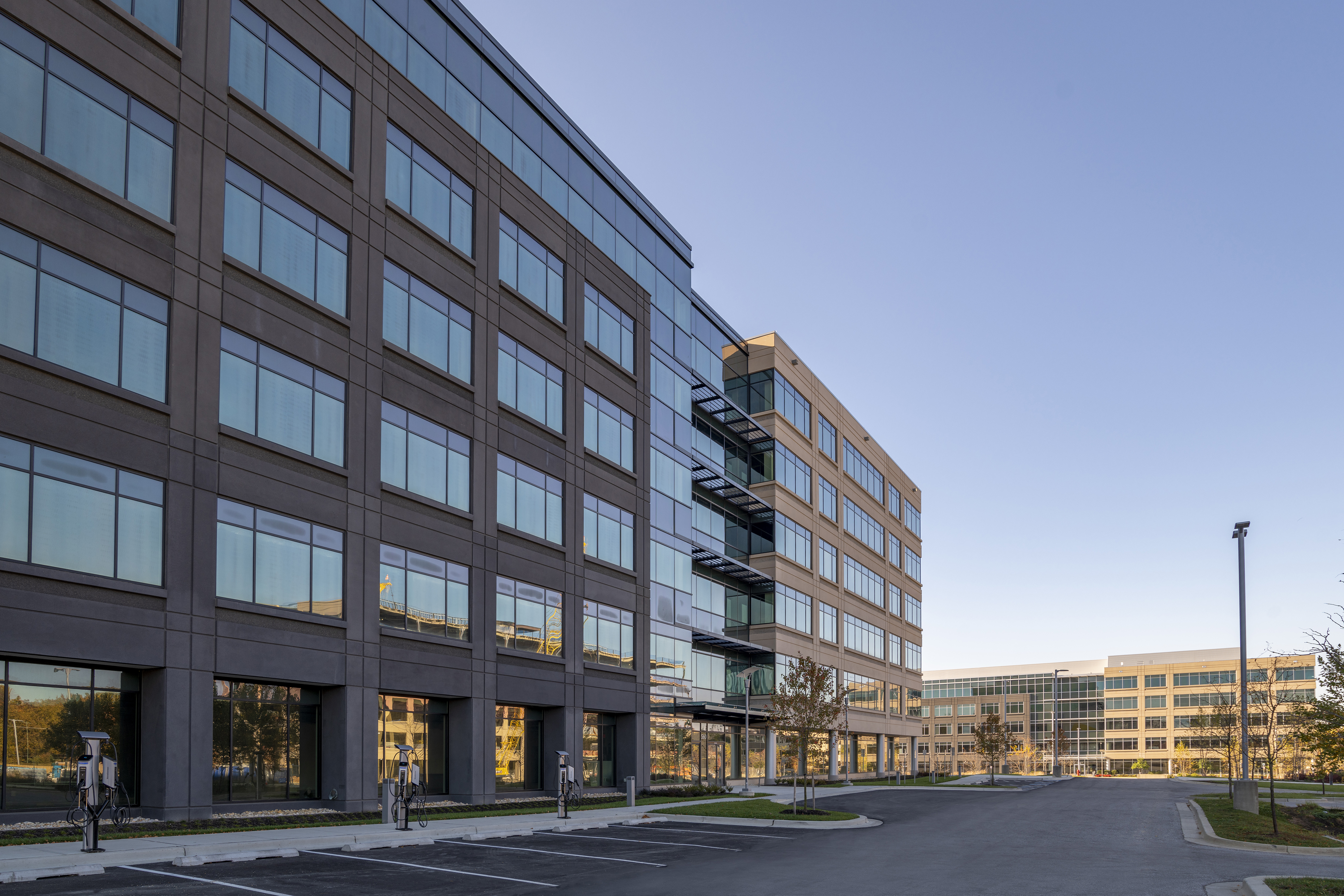
Increases in federal cybersecurity budgets have driven up demand for SCIF space at facilities such as the National Business Park. Photo courtesy of COPT Defense Properties.
SCIF requirements by different federal agencies are constantly evolving and, under a government-wide directive, federal contractors must develop plans by the end of 2025 to meet heightened security standards, likely by 2028. Most of the new SCIF standards place increasing emphasis on TEMPEST — or Telecommunications Electronics Materials Protected from Emanating Spurious Transmission — security.
“Before, we really focused on physically securing a SCIF — keeping people out and protecting it acoustically,” Frels said. “Now, we are talking about data leakage and surveillance. Every time you puncture the envelope of a SCIF, you are potentially compromising it. Any kind of cable could potentially act as an antenna that could allow information to escape.”
Consequently, SCIF design now includes filtering every electrical wire, data cable and other infrastructure connecting to the secure space. HVAC ducts are outfitted with waveguides – steel, honeycomb structures that prevent outside actors from tapping into a SCIF’s radio frequencies.
In addition, meeting SCIF requirements is not an entirely straightforward process.
“It’s a big misconception in the industry that there is a manual that tells you exactly how to build a SCIF,” Frels said. “In reality, there is a manual with a whole bunch of pick-and-choose options and the AO [federal Accrediting Official] decides, based on the particular SCIF and their security needs, which options are needed at that location.”
Due to all the changes and complexities with SCIF design, some companies have worked to develop deep expertise in how to assist owners and tenants of SCIFs.
Arium AE has developed its own manual to aid project teams involved in SCIF renovation and construction. The company recently hosted a summit to provide clients and project partners with detailed, current information about SCIF design standards, product options, challenges, and best design, construction and maintenance standards. Arium AE also collaborates closely with many CRE owners and tenants to help them identify the best locations for SCIFs within buildings.
COPT Defense Properties has assembled a 146-person team (amounting to one-third of its staff) of architects, project managers, operations, and IT personnel, with security clearances and extensive experience in SCIF construction and maintenance. The company designs its buildings specifically to accommodate the buildout of tenant SCIFs in the future.
 That kind of expertise is also helping tenants and owners meet other goals involving SCIFs.
Faced with an extremely competitive market for security professionals and the historic disadvantages of working inside a SCIF, project teams have found ways to make SCIFs a more attractive work environment.
Since windows are not a viable option inside a SCIF, “we’re incorporating different types of lighting that follows circadian rhythms so people get a sense of the light changing throughout their shift,” Frels said.
“We are also seeing more integrated design where a client says, ‘I have unclassified space over here and classified space over there, and I want it all to appear as Class A office,” he said.
Thoughtful design decisions, including selections of art, have helped clients achieve that goal.